
Invited Speakers
The Autosub AUVs - Multisensory, Multi-scale mapping from the Polar Seas to the Tropics
Speaker: Steve McPhail Institution: National Oceanography Centre, Southampton, U.K. Date: October 10th, 2013, 09:15h-10:15h

CV: Steve McPhail joined the Institute of Oceanographic Sciences, in 1981, moving to NOC, Southampton in 1995. As an technologist and engineer, he has participated in 25 research cruises over a 30 year career, and currently heads the Autosub AUV group at NOC, Southampton. Recent highlights have been in leading the Autosub technical team which, in 2009, carried out six successful missions up to 60km into the cavity beneath the Pine Island Glacier in Antarctica using the Autosub3 AUV, and, in 2010, leading the Autosub6000 team which helped in the discovery and localisation of two hydrothermal vent sites in the Cayman Trough. He currently leads the development of the Autosub Long Range AUV. Abstract: For 16 years the Autosub range of Autonomous Underwater Vehicles (AUV), designed and built at the National Oceanography Centre, Southampton, have been exploring of the world's oceans. Highlights have been: mapping under Arctic sea ice near Greenland in 2004, exploring underneath the 60 km ice tongue of the Pine Island Glacier in the Antarctic in 2009, and helping to discover the world's deepest and hottest known hydrothermal vent site, 5 km down, in the Caribbean sea. More recently, the Autosub6000 AUV has carried out detailed sonar and photographic mapping of seabed habitats in the inhospitable seas near Rockall and the Darwin cold water coral mounds, North of Scotland, and has taken over half a million overlapping photographs of the benthic habits at 4900 m deep in the Porcupine abyssal plain. In the talk, I shall describe these campaigns, the practical and technical issues, and how things can sometimes go horribly wrong. I'll also describe recent developments and plans for our new very long range Autosub, its trails at PLOCAN Grand Canaria, and its shore based deployments off the north west of Ireland.
Marine Seismics at Sea Past and Present
Speaker: Tim Owen Institution: Carrack Measurement Technology, Dullingham, Newmarket, U.K. Date: October 11th, 2013, 10:15h-11:15h
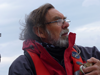
CV: Tim Owen studied Physics at Manchester College of Science and Technology and worked briefly in industry designing Spectrophotometrs before deciding that the University of Cambridge offered more money, travel and most importantly, fun. Arriving in the Geophysics Department at a time of enormous intellectual excitement with the understanding of sea floor spreading and ideas of plate tectonics gerninating, he joined, and later ran, the labs and workshops whose technical expertise underpinned these scientific advances for the next 40 years. For much of that time he ran a design and consultancy company in his spare time, and after taking early retirement designed a number of instruments, including a new sea bed seismic system for a major exploration company. He now restores his house from time to time, and collects and restores antique firearms.
Abstract: Our scientific understanding of the structure of the solid earth, and the vastly important oil industry that underpins most of the world's energy both depend almost exclusively on using seismics to image what we cannot see or dig up. The University of Cambridge has been one of the leading academic institutions involved in developing seismic instrumentation for the last 70 years. This talk looks at the history of that development against a background of the understanding and available technology of the time. It concentrates primarily on work at Cambridge, where most of the emphasis was on marine seismic refraction.
Cambridge made its first refraction meaasurement at sea in 1938, when a successful line involved around a dozen shot-receiver records. A current survey would be insignificant if it didn't yield many millions times as much data. This talk will explore the technology behind these extraordinary changes.